Monday, July 6, 2015

July 1: London Library

On Wednesday afternoon, we visited the London Library.


I recognized the building when we came upon it, as I'd seen it in an illustration and read a description in the book The Professor and the Madman as the place where the idea for what was to be the Oxford English Dictionary was first introduced. (Before our London adventures began, we each had to read two books and write reviews of them. This was one of the books I reviewed.) In its early days, only two or three societies were allowed to meet at the library, and the Philological Society was one of them. It was at one of their meetings at the library that a member gave a talk and proposed the creation of a comprehensive English dictionary. 

The London Library was founded in 1841. It is a subscription lending library, serving around 700 members. Some members come in frequently, and some never come at all; this library will e-mail or mail copies of some materials to its members. From what our tour guide, Mary, said, it sounds like the staff there really develop a relationship with the members and consider their preferences and habits when making decisions about acquisitions and things. Nonmembers may still come and get a day or week ticket to see something in the collection, as long as they can make a case that the item cannot be found anywhere else.

The library has over 72 miles of shelving containing 800 volumes, some dating back to the 16th century. The older shelving was interesting (if not a little nerve-racking). The stacks rest on floors of metal grating (made from American steel, which my brother would appreciate) that clatter as you walk across them. Mary said that this actually helps with air circulation and, in the case of flooding, the rooms drain and dry out more quickly to minimize damage. They are carrying the grating motif throughout the newer additions to the library, to blend the old with the new. 


The London Library came to be because Thomas Carlyle, supported by Dickens, Tennyson, and others, were unhappy with the reading room at the British Museum. Much of the collection is donated, and major (and famous) benefactors' portraits hang on the walls of the staircase throughout the building. There is even a portion of the building called T.S. Elliot House. Elliot was a president of the London Library until his death, and his wife bequeathed a great amount when she died.

The library is in the middle of a capital campaign, in an effort to update and expand the building. As it stands, the library has six floors in the central building and seven floors at the back.

The library has its own classification scheme, which it neat, but can make searching tricky. Some of the materials are still cataloged in the old, bound catalogs (pictured below), not online, so a librarian often has to search in both places. In addition, while they want to stay true to the original catalog, they must modify it slightly to accommodate modern topics. You can see in the second picture how they are still using the older catalog volumes and writing in modifications.


While the library restricts itself to its membership (which I'm not always a fan of, when it comes to libraries), the London Library does seem to accommodate anyone who wants to see its unique materials. As hot as it was that day, the library felt inviting, welcoming anyone to come see the treasures it holds, and a quiet place to enjoy them.

July 1: British Library

On Wednesday morning we visited the British Library.


The collection was originally housed at the British Museum.Its current location was designed to look like a "ship of knowledge." You can see it in the shape of the building, shown in this model...


...and in other design features, such as windows shaped like portholes throughout the building.


The British Library is a legal deposit library (meaning that it receives a copy of every publication in the UK--like the Library of Congress does in the US). The collection contains more than 150 million items, with 3 million items added every year. In fact, if you looked at 5 items each day, it would take you 80,000 years to see the whole collection.

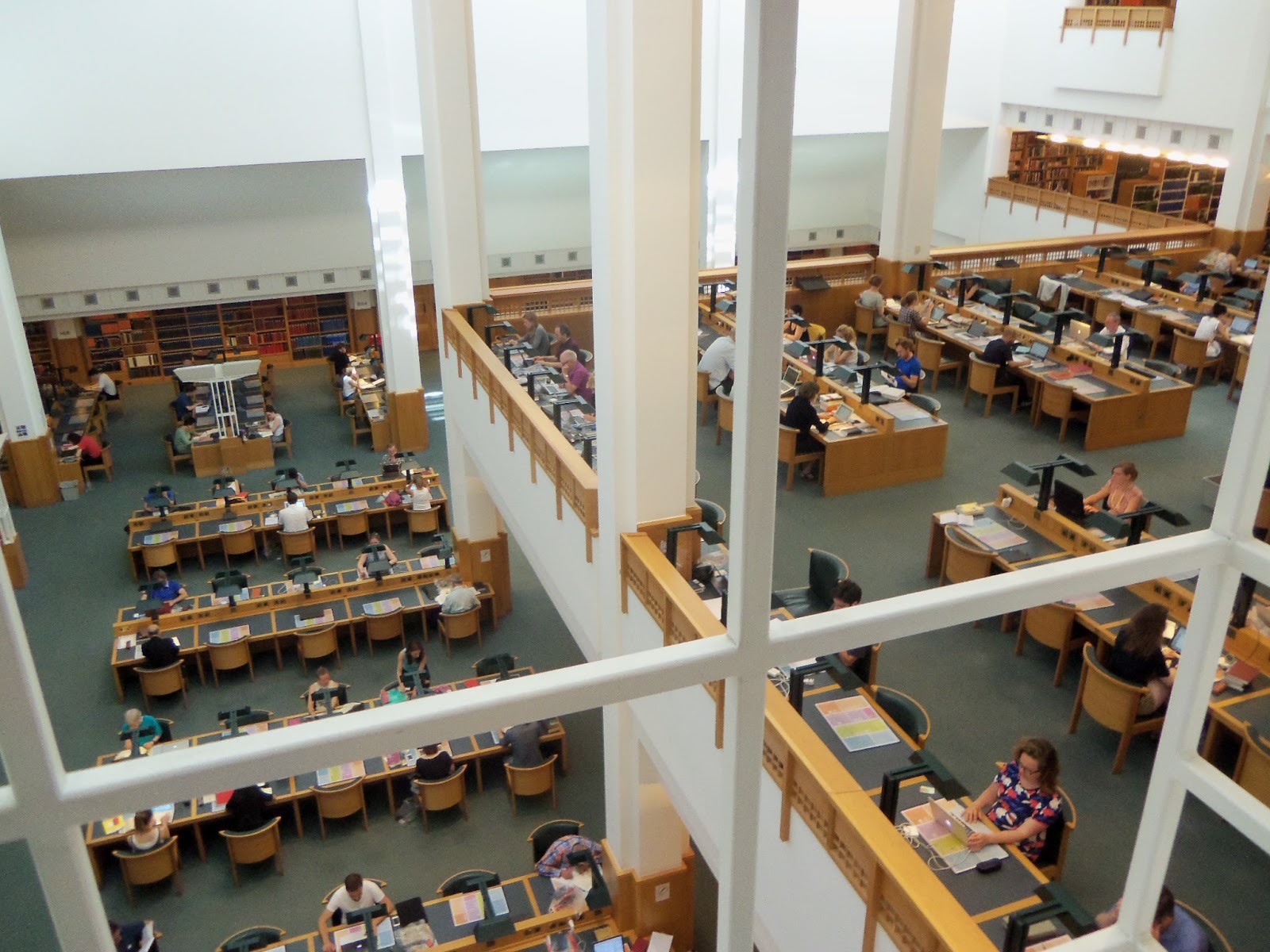
This is not a lending library--the materials stay on the premises. There are 11 reading rooms for readers to use, with a total of 1400 seats. The one shown here is the largest.


To access materials at the library, a user must apply for a reading card, search the catalog for the items they want, then place their order. Materials are housed onsite and at another location in Yorkshire. If the material is onsite, the waiting time is about an hour. If the material is stored offsite, there is a fee and a two-day wait. Readers can register and preorder in advance of their visit, however, so that the materials are ready when they get there.

Most of the materials at that location are stored underground (the tube actually cuts through some of the floors; workers can hear trains pass by on the other side of the wall) in a low-oxygen, temperature-constant environment. The delivery process is fully automated. Materials are sorted by size and chronological order (no Dewey or other classification system). A worker receives an order, searches by number, scans the item, and sends it up to the main floor in trays via an elaborate conveyor system containing miles of track. Some materials can travel for 15 minutes, depending on where they're stored.  

Among its many treasures, the British Library has King George III's library, comprising 85,000 volumes. King George IV donated the collection with the stipulation that it be kept together and on display at all times. The designers of the current building honored this requirement by housing the collection in a glass enclosure running down the center of the library--for six floors.


As impressive as this looks, I think the coolest thing about this is that the collection is still accessible (as long as you can make a case for why you need to see that specific edition; I'm finding that this is the idea of "access" for many libraries here). Readers can request items from the collection, which still follows its original cataloging scheme; around 50 to 60 items are viewed each day.

It's a beautiful building, with tons of material and information available (I could see my classmates light up when thinking about using this library to access material for their papers). I'm glad this huge repository of "good stuff" is available to the British public...and its visitors.


Sunday, July 5, 2015

June 30: Oxford

After our tour of the Bodleian, we were free to explore Oxford on our own.

Yes, Mom, I took lots of pictures. And, yes, it looks just like it does on TV.

We saw the Radcliffe Camera. I've seen it so many times on TV, that it was surreal to see it in person.


I did some damage in the Bodleian gift shop.

We had lunch at the Eagle and Child, where C.S. Lewis, J.R.R. Tolkien, and the Inklings frequently met. They have yummy mac and cheese.


Did more shopping...

...and toured Christ Church College. (Does the stairwell look familiar? We weren't able to go into the main hall, which was the inspiration for the Great Hall in Harry Potter.)


This last photo is of the garden Alice Liddell (the real Alice) played in as a child. Her father was the Dean of the College.


June 30: The Bodleian

On Tuesday, we all got up, bright and early, to take a bus out to Oxford to visit the Bodleian Library.


Oxford is home to 38 self-governing graduate and undergraduate colleges with their own libraries; these are federated under Oxford University, and the Bodleian serves as the central library.

The Bodleian is also a deposit library, meaning that it receives copies of every book published in Britain (much like the Library of Congress in the US). The Bodleian receives two copies of each book (though it doesn't necessarily accept every book): one copy can be lent out and the other is kept in the library as read-only.

The tour started in the Divinity School room, first built in the 1400s as a theology lecture hall. (Harry Potter fans may also recognize the Eastern end of the hall as the Hogwarts infirmary.)

It's a beautiful room in late English Gothic style, with ornate carvings along the walls and ceiling. The designer even had is initials carved in various places in the ceiling (W.O. for William Orchard).

Next, we went into the Convocation House, where Masters of Arts would meet to make decisions about the college. Now, it is only used when a new chancellor or professor of poetry is elected.

The Chancellor's Court served as the College's own civil and criminal court, separate from the town's court. Students at the time were aged 14 to 18, so this was an attempt to settle problems within school walls. Oscar Wilde answered for unpaid debts here. Having two courts in one town made for some tension, understandably, so the Court finally relinquished its powers in the 1960s.

We weren't allowed to take pictures of the second floor, and we had to be super quiet so as not to disturb the readers (our tour guide spoke to us softly through headsets), but it was a librarian's fantasy: floor-to-ceiling bookcases, a wood-paneled ceiling sporting Oxford coats of arms, and a gallery providing access to the upper shelves. The books used to be chained by their front covers to the shelves, so that readers could not remove them from the library. Readers would have to sit at desks in front of the shelves and read them there.

Photo taken from: http://www.curveworkplaces.co.uk/office-furniture/bodleian-library-creates-bespoke-chair-competition/

The center of this space, called the Duke Humphrey Library, is considered the birthplace of the Bodleian. It used to contain more than 280 handwritten manuscripts collected and donated by Humphrey, Duke of Gloucester (the younger brother of King Henry V). The age of print and the Reformation made this collection short-lived (the manuscripts were considered part of the Roman Catholic order) and the collection was disposed of. Only 47 manuscripts remain, 5 of them are in the Bodleian. Talk about a case of weeding gone wrong.

Photo taken from: http://www.cotswolds.info/places/oxford/bodleian-library.shtml

The chance to visit Oxford and the Bodleian was a key reason I applied for this study abroad program, and it did not disappoint. To see such a beautiful, historic place still standing and in use is a magical thing.

Oh, one more thing: here's a cool link to the sounds of the Bodleian, a live audio feed of the Bodleian's various libraries and reading rooms.

Saturday, July 4, 2015

June 29: Bonus Track--Evensong Service at Temple Church

On Monday evening, a small group of students joined Dr. Welsh and attended Evensong Service at Temple Church.

Photo by Dr. Welsh

There was a Magna Carta display in the entrance to the church, with copies of the Magna Carta as well as the Declaration of Independence--five of the men who signed the Declaration, and seven of the men who signed the Constitution had been educated at the Inner and Middle Temples. One of these is ancestor of one of my classmates. He was excited to see his ancestor's name inscribed on the wall of the church.

The music was beautiful, and I enjoyed watching the younger boys singing. Some of them were so serious and really into what they were singing. The church and courtyard were also beautiful. It was tucked away through an entrance off the street. If I were by myself, I don't think I would have known it was there.


It was a quiet, reflective end to a busy day.

June 29: Museum of London

In the afternoon, my group visited the Museum of London. The exhibits are organized along two floors, so that you enter from the entrance into 45,000 BC and gradually move through each time period into the present day.

I liked the way some exhibits were presented. For example, the collection from the Victorian period was presented as wares in shop windows.


They had a few Victorian sewing machines, so of course I took pictures of those.

I've been watching a lot of programs that take place during or after World War II (e.g., Bletchley Circle, Murder on the Home Front), so I was interested in the exhibit on that period. In addition to artifacts like ration booklets, photos of people sleeping in the Underground, air masks, and incendiary bombs (below), the room played audio and video accounts of people recounting their experiences as children. One man described what it was like sleeping in the Underground and then going up above in the morning to take in the damage. As a boy, he helped pull bodies out of the rubble. I can't imagine that. The photos and audio accounts made the experience more real for me than, I think, the artifacts alone would.

Now that I think about it, the museum incorporates a lot of different media into its exhibits. Interactive features are built into the displays themselves, or nearby, that allow visitors to click and learn more information through additional text, images, or activities. Some rooms, like those covering the Great Fire of London, the Plague, and World War II (the cheerful rooms) surround the visitor with video to convey the magnitude of the events they depict. There was even a tiny movie theater on the lower level with velvet seats and fabric covered walls that showed early films.  I took a picture, but, sadly, it didn't come out very well.

I saw on the museum's website that they also have a digital storybook that children aged 10 and older can use to explore the museum, called The Four Givens. Parents can download the storybook from the website or borrow an iPad at the museum.

What struck me most about this museum was its ability to present the breadth of London history so simply. I got a sense that items were carefully chosen and arranged in a way that didn't feel crowded or overwhelming. And the interactive features made each period of London's history come alive.

Wednesday, July 1, 2015

June 29: The London Archaeological Archive and Research Centre (LAARC)

So...maybe posting something every day was unrealistic. Our days have been so jam-packed, that I finally have the chance to catch my breath and put some of my thoughts to blog post.

On Monday, we split up into two groups. My group spent the morning at the London Archaeological Archive and Research Centre (LAARC). We toured one of three LAARC facilities, located in a nondescript warehouse down a side road. It felt very much like an "undisclosed location."

To look at it, you wouldn't know that the building contains miles of artifacts that document the social and working history of Greater London. In fact, as of 2012, LAARC holds the Guinness World Record for the largest archaeological archive in the world. The LAARC has information on around 8,500 archaeological sites in London, and houses the full archives of around 3,500 sites. The bulk of these archives are post World War II, as bombing around the city left holes that revealed many treasures, including the remains of Roman temples and Medieval fortifications. These days, most finds occur when a building is being built or renovated in the city. It is the law (since 1990) that any building plans include a plan for archaeological excavation (at the builder's expense). As a result, many designers try to build as shallow and small a footprint as possible, to minimize the need for major excavation.

Kat, the Learning Program Manager, first took us through a part of the warehouse containing nothing but moving stacks of uniform boxes and boxes (and boxes) of bone and pottery, organized by the earliest date and site of a particular digging project. I thought it was odd they were organized by the date they were found, rather than the date they originated, but Kat explained that people usually search by dig project/site. Archaeologists are most concerned with where something was found, what it was found with, and what is was found in.

Artifacts are grouped into registered finds (those unique, distinguishing objects you might see on display in a museum) and general finds (bits of pottery, iron nails, and other odds and ends), which are more likely to be found at a site. As a group, the content and percentages of general finds at a site can provide a lot of insight about how a particular area was once used.

One of the general finds Kat showed us--and let us hold (!)--was a brick that had been totally incinerated during the Great Fire of London in 1666. The brick had been in the basement of a shop around the corner from Pudding Lane. They have reason to believe that barrels of tar were stored in this basement, which explains why the brick is absolutely charred through, and hints at the huge explosions that must have occurred in the city during those five days. We aren't able to post pictures from the LAARC facility, but here is a picture of a couple of similar bricks on display at the Museum of London.
Bricks burned in the Great Fire of London in 1666

Different materials are housed in separate areas, as they have different preservation requirements. For example, bone and pottery are pretty stable and are kept in plastic bags and grouped in boxes; paper requires acid free materials; metals are packaged with silica to prevent erosion; and plastics are just a nightmare, because they aren't made to last.

This video from the LAARC website shows how the artifacts are packaged and stored.


In addition to the boxes of pottery and bone, which some poor guy was painstakingly repackaging and relabeling behind us while we visited, Kat showed us some other items in the archive: a flint hand axe dating from the Paleolithic, parts of a Roman Italian marble plaque, burnt and petrified seeds from an old bakery that caught fire in 120 AD, burnt thatch from Shakespeare's Rose Theater (which is currently buried and preserved under the Financial Times building in Suffolk), a tiny (and still intact!) glass tear-catching vessel from a Roman mausoleum, and a very fancy, long-toed leather shoe that is thought to have been confiscated from an unauthorized maker and thrown into the Thames. The leather of the shoe was so thin and the workmanship was so fine, that I was amazed at how well-preserved it was.

This was a true "behind the scenes" tour. Not only were we able to see how a massive amount of artifacts is processed and organized (which gives me hope for my own piles of family artifacts in my closet[s] at home), but we got just a glimpse of the massive amount of information and material there is (and is yet to be found) about the long and layered history of London.